
24-HOUR EMERGENCY LINE: 1-844-808-4904
One of Canada’s top economists says Canada has a window now to rebuild its industrial base

Stéfane Marion says Canada has the cheapest energy in the G7, the smallest manufacturing sector, and a closing window to fix it
Stéfane Marion hasn’t been this optimistic about Canadian reindustrialization in more than a decade, and he was smiling ear to ear telling Rooted why.
After a decade of regulation that closed off Canadian resources to Canadian industry, he sees Ottawa opening the door to processing and building more in Canada, with Canadian resources.
Marion, who is chief economist and strategist at National Bank of Canada, had just opened the two-day Spartan Controls conference, Experience Industrial Innovation, where more than 1,000 engineers, researchers, executives, and policymakers had gathered to discuss what Alberta builds next.
He ran through 60 slides in 20 minutes that covered the global oil shock, Canada’s manufacturing decline, and the policy turn that has him optimistic.
He joked from the stage that the organizers put an economist first because the program could only get better from there (astronaut Chris Hadfield was the closing keynote for the conference).
But joking aside, Marion got the morning slot because the macro picture is what Canada and the energy industry have to navigate now. Land, capital, regulation, energy, technology, and community all sit inside an economic frame, and the decisions Canada makes about how to build, invest, and operate inside it will shape the country for the next decade.
That macro picture was striking.
Marion said Canada has the second-largest natural gas reserves in the world, electricity prices for businesses that are competitive with China’s, fresh water in abundance, and trade agreements covering much of the global economy. Despite this, Canada’s manufacturing sector is the smallest in the G7 which is a sign of how far the country has drifted from using what it has.
In Marion’s view, Canada has spent the past decade making its own resources inaccessible at home, then importing back the finished products those resources could have made. Reindustrialization runs on natural gas, and for a decade Canadian producers have been asking whether their own country will use it. Marion thinks the answer is finally yes, and the window to act is open now.

The cost advantage Canada hasn’t let itself use
Reindustrialization is a word economists use, and for the people who produce energy in Canada, it has a direct meaning. Marion described natural gas as the second-largest source of power used by Canadian manufacturers, after electricity. The health of Canadian manufacturing and the demand for Canadian natural gas are connected.
Marion’s read of the past decade is that the connection has been working in the wrong direction.
Canadian manufacturing has been in recession for 34 straight months, he told the conference. The sector’s trade deficit is approaching 8% of GDP, meaning Canada now imports far more manufactured goods than it makes, he said. The scale of the decline became clearer when he pulled up a chart comparing Canada’s share of global manufacturing output to that of other countries.
“We now have a country of 41 million people that has a manufacturing sector that is smaller than Ireland’s, and they have no commodities,” Marion said. “They were able to double the size of manufacturing in 10 years by having a competitive tax regime and less regulation.”
The contradiction inside the decline is that Canada has exactly the cost structure manufacturing needs. Electricity costs Canadian businesses about 60% less than the G7 average and roughly 30% less than in the U.S., putting prices on par with China’s, Marion said.

Natural gas prices are also among the lowest in the world, and Marion believes that should make Canada one of the most attractive places on the planet to run a factory.
His argument is that years of layered regulation made those advantages impossible to use.
There are more than 320,000 federal regulations across the Canadian economy, with roughly 110,000 of them affecting manufacturing alone, Marion said. The rules that limited natural gas as a power source for industry was the single largest obstacle, he said, because it cut Canadian manufacturers off from their own inexpensive energy supply.
That framework recently changed.
In May, the federal government replaced its Clean Electricity Regulations with a new National Electricity Strategy that allows natural gas to play a substantive role in the grid. For Canadian manufacturers, that means access to the cheapest energy supply in the developed world. For Canadian gas producers, it means a federal market for what they produce.
“For the first time in a long time, Ottawa is actually deploying policies that are conducive to reindustrialization,” Marion said.

He is careful about what that opening guarantees.
The policy turn is necessary, but it is not enough on its own. What happens next depends on whether the country moves fast enough, and whether the regions that do the building have the appetite to lead.
“For too long, our aggregate policies have been shaped by the Toronto-Montreal corridor,” he said. “That needs to change.”
Marion sees the existing pipeline from Alberta to Eastern Canada as part of that change.
Roughly half of Ontario and Quebec’s natural gas currently comes from the United States, while pipeline capacity from Alberta has been sitting underused for a decade because the old regulatory framework discouraged long-term domestic supply contracts.
Putting that pipeline back to work, in Marion’s framing, is both a national unity and national security issue.

Alberta is ready to build
If Canada has a window, Alberta is where it opens first.
Marion put a Canadian Federation of Independent Business scorecard up on screen at the conference, ranking provincial and federal regulatory efficiency. Alberta scored A. The federal government scored C+. No other province scored higher than Alberta.
Nate Glubish, Alberta’s Minister of Technology and Innovation, said the province is months away from a wave of major industrial projects clearing the final approvals that release capital and start construction. The technical term is a final investment decision (FID) which is essentially a green light to start building.
“In the next three to six months, I think you’re going to see significant FIDs on projects that would be gigawatt-scale projects that have everything from the customer, to the gas, to the electricity, to the water, to the fibre and to the financing, all packed up,” Glubish said at the Spartan Controls event.
His argument is that the first wave matters more than the later ones. Once Alberta proves it can deliver something at that scale, capital that has been searching the world for places to build will start to converge here.
“Once we get the first series of large [data centre] campuses, that proves to the world that you can build something that big here, and it creates that sense of urgency among the folks who are desperately looking all around the world to say, ‘how can I get this much capacity?'” Glubish said.
The province’s offer is speed and certainty.
Glubish said Alberta will not provide grants, tax credits, or loan guarantees. Most other Canadian provinces compete for industrial investment with some combination of those tools.
In Alberta, Glubish says the province is focused on competing on regulatory clarity and on a single point of contact inside government that has, in at least one project, brought permitting time down from 28 months to 14, he said. For investors choosing between jurisdictions, certainty about timelines is often worth more than tax credits.
One project on the roadmap south of Grande Prairie sits at the intersection of three of the industrialization arguments Marion was making at the conference.
CSV’s Gold Creek facility, which is on the company’s roadmap for development, will feed critical mineral supply chains when it’s operational. The plant is designed to recover up to 370 tonnes of sulphur a day, an input used in lithium extraction and domestic fertilizer manufacturing. Both are supply chains the federal government has committed $3.8 billion to secure, and that Canada currently sources largely from outside the country.
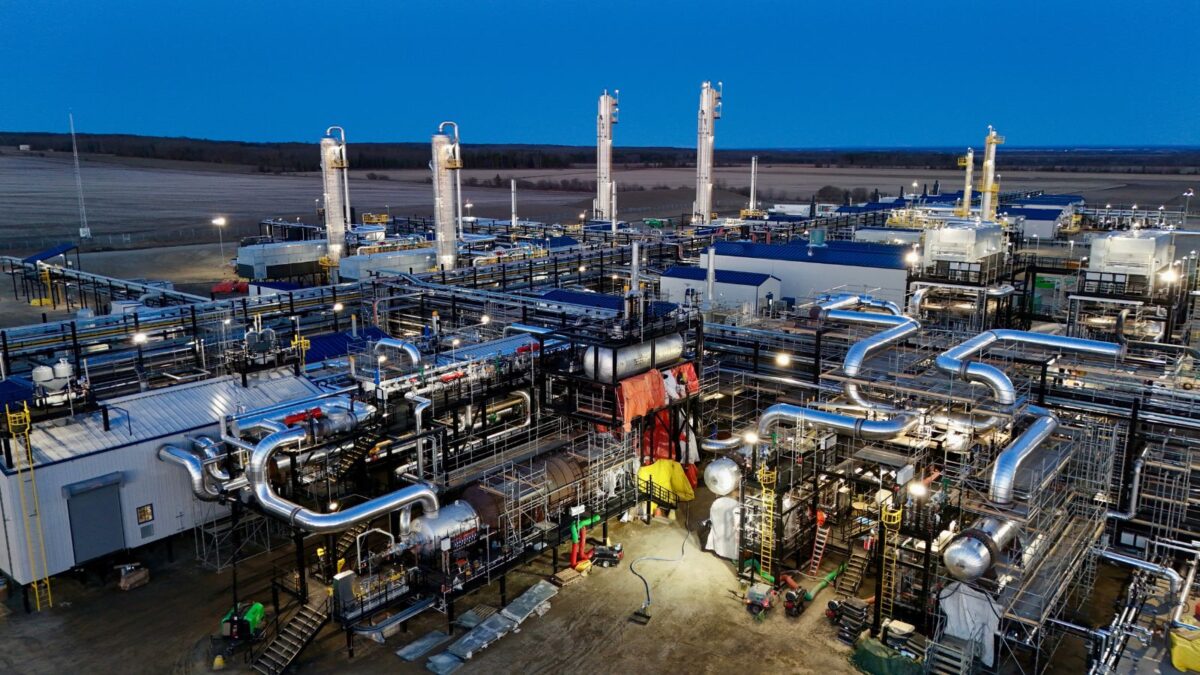
CSV’s Gold Creek facility will also reduce dependence on U.S. imports.
The Montney formation it will draw from is rich in natural gas liquids, including condensate which is the diluent Canada uses to thin heavy oil for transport to market. Rystad Energy data shows Canada currently imports roughly 260,000 barrels of condensate a day from the U.S. Processing more Montney gas at home means more domestic supply, and in the current trade environment, a domestic substitute carries strategic value.
It also underwrites Canada’s bid for AI infrastructure.
Gold Creek sits adjacent to the proposed site of Wonder Valley, an AI data centre campus projected to attract more than $70 billion in investment at full build-out. The campus will require large-scale natural gas supply to operate, and CSV’s Gold Creek facility is positioned to provide it.
For CSV, building at scale also requires getting communities behind a project before construction starts, and delivering infrastructure that creates shared value for the region.
Gold Creek has received provincial regulatory approval and will be completed by 2029, pending a final investment decision in 2026.
The facility is modelled on CSV’s Albright plant that sits west of Grande Prairie. It came online in November 2025 and was the first greenfield natural gas plant with sulphur recovery built in Alberta in more than 30 years.
A portion of Albright’s annual revenue supports the Creating Shared Value Fund, managed at arm’s length by a volunteer committee of local residents who review proposals and direct money toward projects in the County of Grande Prairie. Where it goes is decided by the people who live there.
Gold Creek is designed to extend the same model south of Grande Prairie.
“The fund will provide material benefits to the communities most impacted by development, including smaller rural communities and Indigenous communities where real needs and opportunities exist today,” said Daniel Clarke, President and CEO of CSV Midstream Solutions.
A share of Gold Creek’s revenue (not profit) would feed the same structure, with a community-led committee directing funding toward priorities residents identify themselves.
“By directing investment toward priorities identified by local community themselves, the fund creates a meaningful partnership model that delivers tangible social outcomes while ensuring economic development and community prosperity advance together,” Clarke said.
Projects like Gold Creek are what Marion’s argument looks like on the ground. Whether enough get built fast enough by the industry writ large is the question for the next two years.

Why building at home is also better for the planet
The natural question that follows any argument for building more Canadian industry is what it does for emissions. Marion has a clear answer, and he says it depends on what gets counted and where.
“It’s totally abnormal that we send raw resources around the world, then reimport transformed resources,” Marion told Rooted. “And where our natural resources are transformed in other countries, they’re using processes that are dirtier than the ones employed in Canada.”
Canada’s electricity grid produces roughly a quarter of the carbon emissions per unit of power that the U.S. grid does, and about a sixth of what China’s grid does. When a Canadian molecule of natural gas is processed into plastic in China and shipped back to Canada as packaging, the carbon math is worse for the planet than processing it in Canada would have been.
The economic math is similar.
Canada sends raw materials out and buys them back as finished products at higher prices. Canadian crude leaves the country and returns as gasoline, diesel, and petrochemical feedstocks. Canadian natural gas leaves and returns as plastics, fertilizers, and chemicals embedded in everything from packaging to building materials.
The value added in between accrues to whichever country does the work.
And on the emissions front, Marion’s argument is that decarbonizing by sending industry elsewhere is not decarbonization.
When Canadian production shuts down, global demand for the product does not, and so the product still gets made, shipped, and consumed in a jurisdiction with a higher carbon footprint, with the goods travelling further to reach the same end markets. The Canadian inventory looks better on paper while the atmosphere stays the same.
“The very easy way to decarbonize is to shut down all of our industries in Canada and pledge to the world that we are decarbonized,” Marion said. “But we will be forced to import everything we consume. I don’t think that’s the right path for the progress of the planet.”
Marion thinks Canada is finally in a moment where that argument can get traction.
Marion wants Ottawa and the country to move faster on major energy and resource projects, treat the regions that do the building as central to economic policy, and use what Canada has, at home, to make what the country and the world need.
