
24-HOUR EMERGENCY LINE: 1-844-808-4904
Grande Prairie’s growth shaped by energy, infrastructure, and people
On a map, Grande Prairie still looks like a regional service centre shaped by agriculture, forestry, and energy.
On the ground, the city is in the middle of both a growth spurt, and a shift.
Over the past several years, the city has been investing in land servicing, utilities, education, and workforce planning to support growth as population and industrial activity increase. Those investments have expanded capacity across multiple systems.
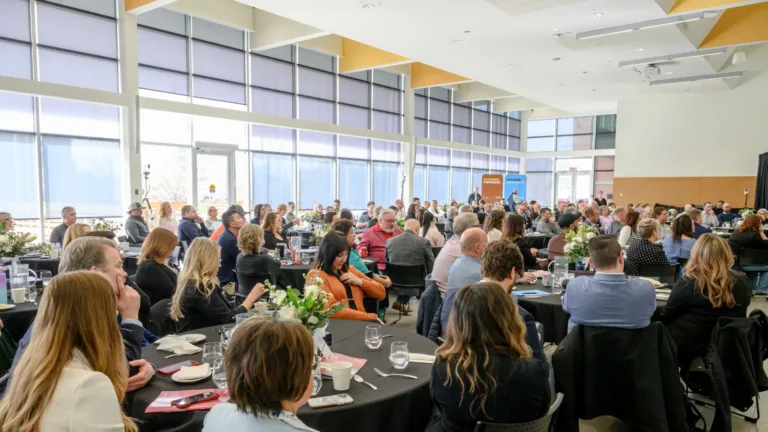
Earlier this year, the city’s State of the City event and its 2024 Annual Report outlined how those priorities are being carried forward. Long-range planning and coordination across municipalities, industry, and post-secondary institutions are playing a larger role in how Grande Prairie approaches development.
This is not a story of sudden change. It reflects how a mid-sized city is reshaping how it plans for growth.

A hub shaped by cycles
Grande Prairie has long functioned as a regional hub, though the industries defining that role have shifted over time.
“Grande Prairie was first known as an agricultural hub, then it expanded rapidly as an energy hub,” Mayor Jackie Clayton said to CSV in an interview at the city event earlier this year. “In between, it was known as the forest capital of Canada. The reality is we’ve always been that hub.”
That mix of sectors also shaped a service economy that extends beyond resource industries. Health care, professional services, tourism, and education now sit alongside traditional industries, supporting a regional population of nearly 300,000 people.
The city’s urban population, including surrounding county residents, has surpassed 86,000, with a median age of 35. Construction activity increased by 31% last year to $123 million. And airport traffic rose to nearly 280,000 passengers — a 7% increase year over year.
Grande Prairie’s current planning approach reflects lessons learned during earlier growth cycles.
“In the early 2010s, the community was growing at an extremely rapid rate, and the municipal government had no choice but to be reactive,” Clayton said. “It happened so quickly.”
That period reshaped how infrastructure decisions are made.
Today, the city has large areas of residential land already connected to roads, water, sewer, and other basic services, along with industrial and commercial areas ready for development. In 2024, Grande Prairie also completed 31 kilometres of road rehabilitation and invested in stormwater and transit upgrades. Incentives aimed at broadband internet expansion and multi-family housing have also been introduced as part of that effort.
Clayton said the city’s approach reflects lessons from the rapid growth of the early 2010s.
“Having that foresight to put significant investment into infrastructure and transportation networks came from what we learned during that boom,” she said. “Other mid-sized cities are managing that kind of growth now. We’ve already done it. We’re ready for what comes next. We have the infrastructure in place. That comes at a cost, but it’s how you become competitively advantaged.”

Wonder Valley within a changing regional landscape
One of the most visible developments connected to this period of change is Wonder Valley, a proposed multi-phase, AI-powered data centre industrial park located in the Greenview Industrial Gateway.
At full build-out, the project could be valued at more than $70 billion.
“At that scale, it’s one of the largest capital projects contemplated in Canada,” Clayton said. “The magnitude matters.”
Provincial coordination is underway, including a master water licence application and early community engagement. The project places demands on power generation, water access, fibre connectivity, permitting, and workforce availability.
Clayton said the scale of the project has reinforced conversations about energy systems in the region.
“I think that it’s an opportunity for Canadians to not only recognize the value of this region as the economic engine of Alberta, but for us to realize how important natural gas is, and to talk about that power generation as a result of natural gas.”
While the project remains in early stages, its presence is already influencing how organizations assess long-term investment.
“It puts this region into conversations about what’s possible,” Clayton said.
Workforce and education as long-term capacity
Alongside physical infrastructure, workforce planning has become a more explicit focus.
Northwestern Polytechnic has expanded programming in computing science, trades, oil and gas, agriculture, and health care. New student housing is under development, and a health care education corridor is emerging near the regional hospital.
“If we can train people locally, they’re more likely to stay locally,” Clayton said. “If there’s a job for them when they come out of school, that benefits the whole system.”
Transit investments have supported that retention. Free youth transit introduced in 2023 led to a 107% increase in ridership, adding more than 100,000 trips.
More than 80% of residents have lived in the city for more than two years, reinforcing workforce continuity even as the population grows.

Shared responsibility across systems
Supporting growth is not something municipalities do alone, and Clayton said the city’s ability to support growth depends on more than municipal assets alone.
“Communities like ours can’t do it all on our own,” she said.
She pointed to the role of employers and industry partners in sustaining services, non-profits, and long-term opportunity alongside municipal investment.
“Without organizations like CSV and partnerships in our community, and in our post secondary, and supporting locally, we couldn’t do it all on our own,” Clayton said. “This community needs large-scale organizations such as CSV and other players within different sectors to support our community.”
That combination of municipal planning, industry presence, and community organizations shapes how services are sustained and how opportunity circulates locally. When residents see long-term employment across energy, forestry, agriculture, and related sectors, Clayton said, it reinforces confidence in staying and building a future in the region.
“It keeps our community optimistic about what’s possible when we see more people going to work for companies like CSV or coming to work in the energy sector or uptaking in forestry or agriculture,” she said.
