
24-HOUR EMERGENCY LINE: 1-844-808-4904
Buddy Up takes centre ice at Calgary Flames’ Hockey Talks night
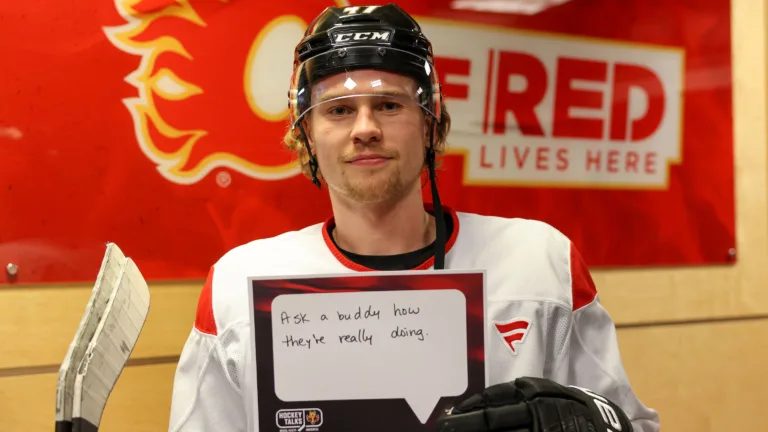
On March 3, the Scotiabank Saddledome looked like it always does on a hockey game night in Calgary. Jerseys in the stands. Players in motion. Pressure on the ice.
What changed was the message that shared the spotlight.
For the 14th year, the Calgary Flames hosted Hockey Talks, joining teams across the NHL in dedicating one home game to mental health awareness. The initiative has supported mental health organizations across southern Alberta for more than a decade while using the visibility of professional hockey to reduce stigma and connect fans with resources.
This year, the focus was Buddy Up, a suicide prevention and help-offering initiative developed by the Centre for Suicide Prevention.
CSV supported the effort as a Buddy Up Champion alongside Mastec Purnell, Breakaway Energy Services, Medallion Energy Services, and Digital Journal Group to help bring the story of mental health and suicide prevention to centre ice this week.
Mental health is not confined to one profession. It reaches into locker rooms, boardrooms, and remote worksites alike.
Approximately 13 people die by suicide every day in Canada, and men account for nearly 75 percent of those deaths. That reality carries particular weight in construction and energy sectors, where workforces are predominantly male and many roles involve remote sites, long shifts, and sustained pressure.
Professional hockey operates in that same kind of high-pressure environment.
Expectations are public.
Performance is constant.
Scrutiny does not pause.

Mental health support within the Calgary Flames
For Craig Conroy, General Manager of the Calgary Flames, that reality is personal. He began his NHL career in the 1990s, when conversations about mental health were rare.
“When I started playing, people didn’t talk about the mental health side,” Conroy told CSV before the game. “You kept things private, and to yourself. It was a sign of weakness.”
He said today’s players face a level of scrutiny that did not exist when he began his career.
“There’s just so much more pressure from everything that’s around the team,” Conroy said.
The organization began confronting that reality in the late 2000s. At first, support meant referring players to professionals outside the rink. Over time, the approach evolved to include full-time support embedded within the team.
“One of the big things when it started was players asking, ‘If I tell them something, are they going to tell the coaches? Are they going to tell management?’” Conroy said. “We’ve always said right from the beginning, ‘Nope, this is you and him. Somewhere you can go and have a safe space and talk to someone and not have to worry about what they’re going to tell us’.”
The objective, he said, is to address challenges before they escalate.
“You have to keep paying attention, and you have to be open to talking about it,” he added. “You have to ask, ‘Is everything okay?’ and really mean it.”
What happens after the game
Hockey Talks raises visibility. Buddy Up focuses on what happens after.
Several years ago, CSV integrated a suicide prevention training program into daily safety practice. Developed by the Centre for Suicide Prevention, Buddy Up was embedded across CSV offices and field sites. The program introduced mandatory training, a tiered skills model, and a visible colour-coded system identifying levels of certification.
Today, more than 4,000 people have completed Buddy Up suicide prevention training through CSV.
Instead of relying on individuals in crisis to ask for help, the program trains coworkers to recognize changes and step in.
“Buddy Up is built on help-offering, not help-seeking,” said Daniel Clarke, CEO of CSV Midstream Solutions. “We can’t expect someone at their lowest point to have the strength to even ask for help. Buddy Up trains the people around them and be that hand up.”
Clarke said CSV’s goal when implementing was to empower people to offer help.
Mara Grunau, CEO of the Canadian Mental Health Association Alberta and Centre for Suicide Prevention, said that shift reflects a broader understanding of how prevention actually works.
“I think the other thing that people need to know is that anyone can help someone who has thoughts of suicide,” she said. “You do not need to be a clinician. You do not need to be a doctor. You do not need to solve the person’s problems. You need to be willing to sit with them in their difficult time and have an active listening ear.”
She said when workplaces, teams, and communities become more comfortable talking about suicide directly, intervention happens earlier and outcomes improve.

On March 3, that message was visible from the arena floor to the upper bowl.
For one night, it shared the spotlight.
In the days that follow, for the thousands in attendance, it moves into smaller spaces. Into locker rooms where teammates notice a change in behaviour. Into job sites where coworkers see someone withdraw. Into offices where a direct question can offer hope.
“How are you doing, buddy?”
And when the answer comes too quickly, just ask again. “No, how are you really doing?”
