
24-HOUR EMERGENCY LINE: 1-844-808-4904
Beyond boom and bust: how Grande Prairie built something that lasts
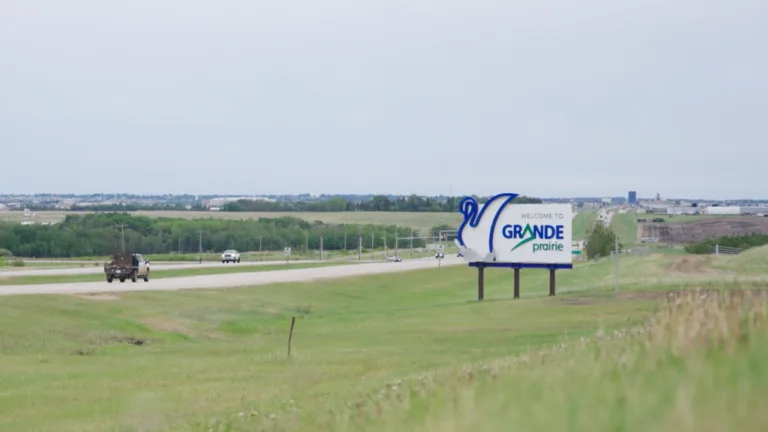
The municipalities stopped competing. The industries started processing instead of just extracting. And the people who came for a few years built careers and raised families instead.
Linda Side doesn’t hesitate when asked what she thinks about Grande Prairie being called a boomtown.
“I hate that with a passion,” she said.
Side is Managing Director of the Side Group of Companies. Her father Al Side built it from a single industrial supply store into a network spanning rail, real estate, oilfield supply, and logistics over 60 years. She has watched the region move through commodity cycles, recessions, and restructuring for most of that time. The boomtown label, she says, has never told the full story.
“When you hear the word boom, what necessarily follows is bust. And I’ve been there,” Side said. “What we have instead is natural cycles. They are just shored up. They used to be larger and deeper, and now they’re just faster.”
That framing matters more right now than it has in years.
Alberta accounted for approximately 59% of Canada’s natural gas output in 2024 and into 2025, according to the Canada Energy Regulator, with production growth driven by Montney Formation development in northwestern Alberta and northeastern BC. LNG Canada began its first exports in June 2025, pulling more Montney gas toward export markets. Pipeline capacity northwest of the city is expanding to meet growing production volumes.
Major producers have been acquiring and expanding their Montney positions in the Grande Prairie area, with hundreds of millions of dollars in drilling activity planned through 2026. In forestry, Weyerhaeuser renewed its Grande Prairie Forest Management Agreement for 20 years in 2022, running to 2042, a sign that one of the region’s oldest industries is deepening its commitment rather than pulling back.
The Grande Prairie–Greenview Corridor recorded 579 housing starts in 2025, a 60% jump from the year before and the highest growth rate among all non-metro regions in Alberta, according to a February 2026 release from Invest NW Alberta.
That residential growth reflects something broader. The same land and energy conditions driving upstream and midstream investment are also drawing attention for large-scale AI data centre development. The Greenview Industrial Gateway and the proposed Wonder Valley campus have put northwestern Alberta into conversations about energy-anchored computing infrastructure.
The people and institutions in this region have been managing growth, navigating cycles, and building for the long term for decades. They have plenty of practice.
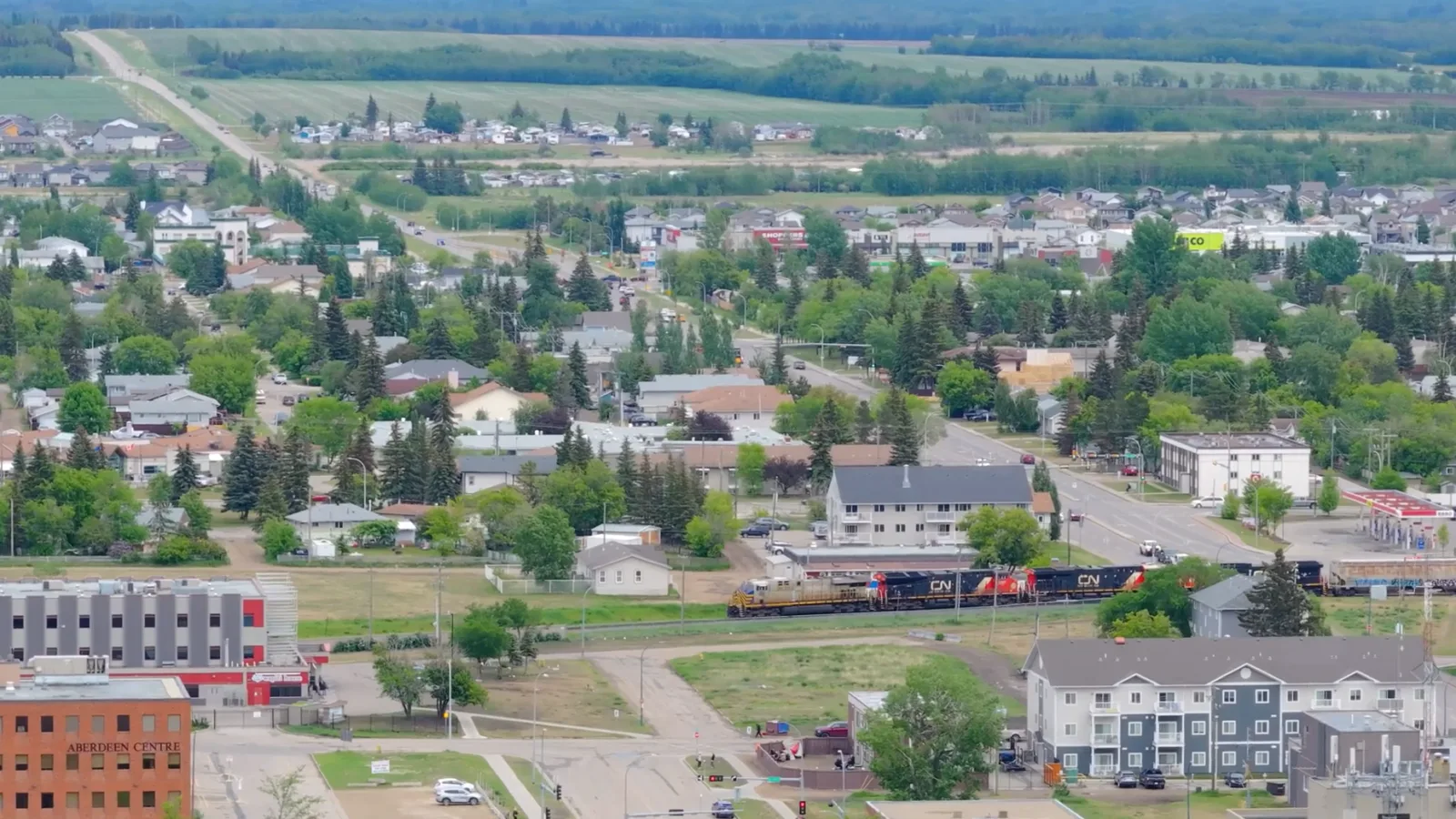
The overlap that steadies things
Grande Prairie’s economy runs on three resource sectors: oil and gas, forestry, and agriculture. Side describes a region that has learned to use that mix as a stabilizer. When one sector slows, the others continue to generate employment, supply chain activity, and tax revenue.
“We’re just less dependent on one industry here,” she said.
Mayor Jackie Clayton puts a number on it.
“We were put on the map for agriculture, then grew as an energy hub,” Clayton said. “Fifty-one percent of all forestry activity in Alberta happens in the north. You take those three sectors and combine them with a service sector, education, healthcare, recreation, and you have a great balance.”
It changes who stays. Side describes a pattern she has watched repeat for decades: people arrive planning to leave, and then don’t.
“You would see people show up with a backpack saying, ‘I’m here, three years max,'” she said. “They get here and decide this is a pretty good place to raise a family.”
Jeremy Walker, General Manager of Side Group Rail, came to Grande Prairie from Vancouver 30 years ago and stayed for the same reason.
“What appealed to me was the absolute fearlessness of the people here,” Walker said. “That frontier mentality and that pioneering attitude really appealed to me.”
Rhonda Side, who manages real estate and land acquisition for the Side Group, describes the region’s character in operational terms.
“We are a community grown from homesteaders and farmers and people who figured out how to do things and get things done without much assistance,” Rhonda Side said. “It’s a really nimble bunch.”
The work that happened before the opportunity arrived
The change that distinguishes this period from earlier cycles isn’t the volume of activity. It’s how that activity is managed.
For most of Grande Prairie’s history, the three municipalities governing the region, the City of Grande Prairie, the County of Grande Prairie, and the Municipal District of Greenview (MD), operated largely in competition. Each had its own land base, its own industrial ambitions, its own relationship with provincial funding.
That changed. Over the past several years, all three have moved toward deliberate alignment on major projects, sharing responsibility rather than competing for it. The most visible product is the Greenview Industrial Gateway (GIG), a planned heavy industrial corridor designed to attract large-scale processing, petrochemical, and AI data centre investment to land already serviced with gas access, transportation corridors, and zoning approvals.
Walker was in the early conversations that led to the Gateway. He describes a moment years ago when the three municipalities hosted an international delegation evaluating the region for a petrochemical project, and fell short.
“We literally were this entity in the middle of nowhere. We were dealing with Crown lands and all of these potential obstacles,” he said. “Our ability to help them get to a decision faster is considerably better than it ever has been. I would say it’s comparable to any jurisdiction that is much more experienced with these types of projects.”
Nolan Dyck, MLA for Grande Prairie, describes the same change as one of the region’s defining distinctions.
“Three main municipalities come together and say, ‘Here’s a project in a specific area, and we all can get behind a single idea,'” he said. “These entities have the option to do it themselves, but they’ve decided to pull together.”
He points to two active examples: the regional bypass around Grande Prairie, which all three municipalities are advancing together, and the GIG itself.
In the GIG’s case, the industrial development and its tax base sit primarily in the MD, while the workers and families it attracts will likely live in the city or the county. A decade ago that kind of imbalance would have been a source of friction. Now all three municipalities have agreed on a different principle.
“There’s an understanding that it doesn’t matter where somebody lands. There’s going to be benefit for everyone,” Dyck said.
Rhonda Side traces the change to geography as much as anything else.
“The city has no more room for available industrial land,” she said. “You can either fight with your next door neighbour, which historically we know is a bad idea, or you figure out how to work with your neighbour so they take care of that need while you take care of the other.”
When growth overlaps
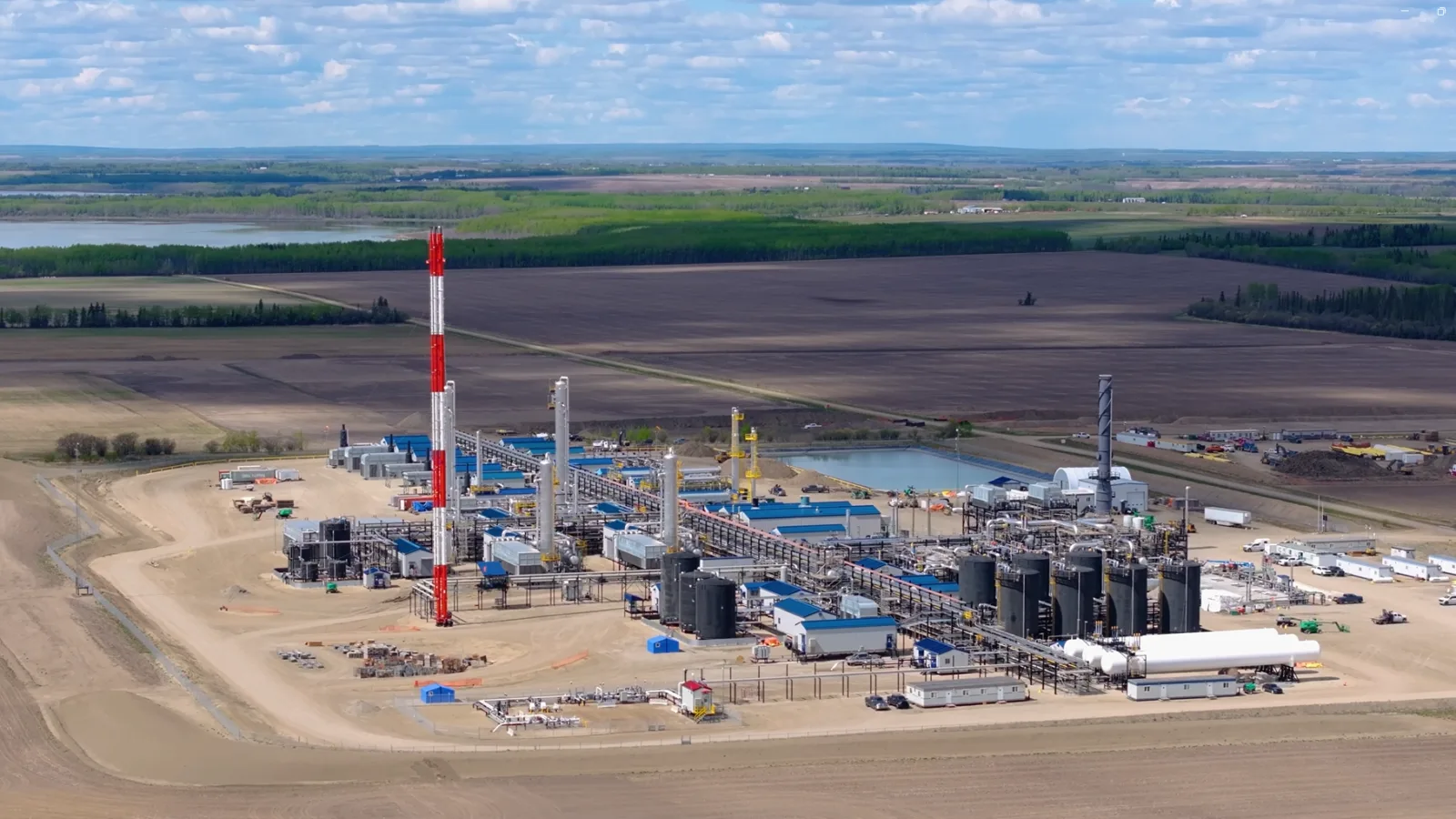
For CSV Midstream Solutions, which operates six natural gas processing facilities across the Grande Prairie region, that collaborative character is part of what drew the company here in the first place.
“It’s a unique community, very focused and very energy supportive,” said Christopher Dutcher, CSV’s EVP & Chief Operating Officer. “We intentionally located our core area up here because of the resource, but also because of the community and the people.”
For CSV, that means local hiring, regional suppliers, and a portion of revenue from the company’s Albright gas plant being directed to a community fund administered independently by the Northwestern Alberta Foundation.
“The goal has always been to make sure the communities around our facilities see real benefit from our presence, not just activity,” Dutcher said. “That’s what keeps us here for the long term.”
Population growth, a proposed multi-phase data centre campus, and rising housing demand are all hitting Grande Prairie at the same time. Clayton describes keeping pace with multiple demands rather than addressing them one at a time.
“In the early 2010s, the community was growing at an extremely rapid rate, and the municipal government had no choice but to be reactive,” Clayton said. “That period reshaped how infrastructure decisions are made.”
The city now maintains residential and industrial land already connected to services. The 2024 Annual Report documented significant road rehabilitation completed that year, and Clayton noted nearly 800 new housing units were added in the same period.
Walker says the pressure isn’t on infrastructure. It’s on people.
“One of the challenges in any place that’s growing is manpower,” Walker said. “We will certainly be competing with other jurisdictions for that.”
For companies like CSV, part of the answer is making the work predictable regardless of how the market moves.
“Our contracts and our plants are supported by long-term take-or-pay agreements, so there’s predictability in our facilities,” Dutcher said. “If the cycle goes up and down, you’re not going to see CSV laying people off. That gives the community some confidence.”
For Dutcher, the consistency CSV offers its workforce is one expression of a broader commitment. The primary business is gas processing, but the investment in the region goes further.
“When you operate in a place for decades, you become part of it,” Dutcher said. “The question is whether you’re intentional about what that means.”
That shows up in how CSV looks after its people. Buddy Up is a mental health and suicide prevention program, developed with the Centre for Suicide Prevention, that gives every CSV employee and contractor the skills to recognize when someone is struggling and reach out. It’s the first program of its kind in Canada’s energy sector.
Investing in community takes a more direct form as well. A portion of revenue from CSV’s Albright facility flows to the Creating Shared Value Fund, administered independently by the Northwestern Alberta Foundation. Local community members decide how the money is used to support local initiatives.
And CSV helps connect and support growing and emerging opportunities in the region, including AI data centre development in the GiG, which draws on the same long-term regional groundwork that makes the area competitive for major investment. “Creating Shared Value starts with understanding that the people around you aren’t a stakeholder category,” Dutcher said. “They’re your neighbours. That changes how you make every decision.”
What stays behind
Linda Side believes the deeper change is generational as much as structural. The people arriving now are more likely to put down roots, more likely to feel attached to the place they’ve landed in, and more likely to act on that attachment.
“Because of this added collaboration, the notion that we have to work together, you’ll see change happen at a more rapid pace,” Linda Side said. “Things will get done.”
That attachment takes different forms.
Rhonda Side co-founded Grande Prairie Reading University with her sister Linda in 2009. The three-week summer programme targets grade three students who are almost at grade level but need a little more literacy practice to make it. It runs every July at Northwestern Polytechnic, with transportation, meals, and supplies provided at no cost to families, and two educators for every 10 children. School districts recommend students each year.
More than 1,200 children have gone through it since the first year, when 32 kids showed up after six weeks of planning. Communities in northeastern BC have come asking to participate, and the Side Group is working to find a way to welcome them.
“It’s the best work we do here. It is the most important work we do,” Rhonda Side said.
The business, she says, is what makes it possible to show up for that kind of work. She’s matter-of-fact about it.
“Purposes is what gives us a reason to get up in the morning. Selling nuts and bolts? Meh. It allows us to find our purpose,” Rhonda Side said.
“It’s a privilege to have the time and the energy to focus on things that will raise the community.”
The boomtown label persists partly because it’s applied from outside, by people who see the activity but not the structure underneath it. What the people inside it describe is municipalities that have learned to share, industries processing rather than just extracting, and a population that has largely decided to stay.
